
Japanese Manicure in Dubai: Vogue Arabia Asks March14
Vogue Arabia asked March14 founder Ruby Barreau why Japanese manicures are replacing gel extensions, and where to book one in Dubai. Her answer, in full.

On 24 August, Vogue Arabia published a report on the return of the Japanese manicure, written by Vama Kothari. The title called our founder, Ruby Barreau, and asked her what is actually happening to nails in this city. Our thanks to Vogue Arabia for the question, and for asking it of March14.
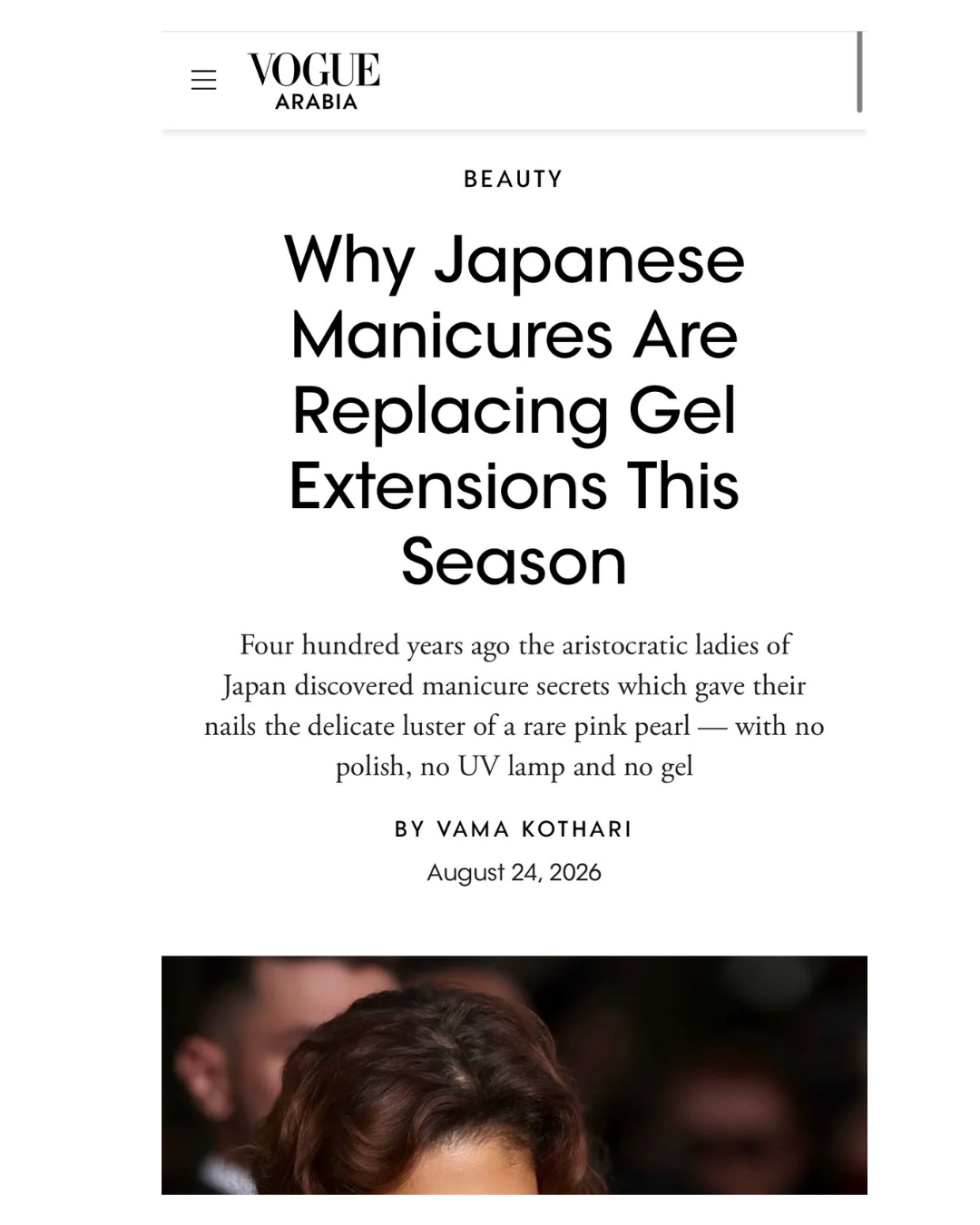
The shift Vogue Arabia asked us to explain
Gel extensions held their moment for a long time, and for a good reason: immediate length, and length that survives daily life. That demand has not gone anywhere. What has changed is the priority sitting underneath it. Clients now want to grow their own nails and protect that length with builder gels and fortifying systems, rather than adding another set on top of the last one. As Ruby put it to the magazine, they are "looking at what is underneath the manicure now" — not only at how long it lasts.
The question asked across the table has changed with it. It used to be what will survive the longest. It is now what is in the product, whether a healthier version exists, and whether the nail underneath can be brought back.

Does gel damage your nails? The honest answer
Gel is rarely the villain. Years of extensions do not have to mean years of damage, provided the formula, the application and — above all — the removal are handled correctly. The harm almost always comes from the process rather than the product: over-filing, over-buffing, lifting away layers of natural nail along with the gel.
That distinction decides the recovery. A nail that has merely dehydrated or softened comes back quickly. A nail plate that has genuinely been thinned has one remedy only, and it is patience. Fingernails grow at roughly 3mm a month, which puts a full, honest reset at up to six months.
It is not the answer that sells the next appointment. We give it anyway, because the alternative is a client who spends three more years covering a problem instead of six months ending it. That is the whole of our Healthy Nails Lab in one sentence.
What is a Japanese manicure?
The technique is four hundred years old, developed by the aristocratic women of Japan, and it produces nails with the soft luster of a pink pearl — without polish, without gel and without a UV lamp.
Rather than sitting a product on top of the nail, a Japanese manicure works into it. A vitamin-rich paste built around beeswax, keratin and mineral silica is pressed into the nail plate with chamois buffers, then sealed with a fine powder that closes the surface and holds the nutrients in. The shine belongs to the nail itself, not to a coating. The result typically holds for two to three weeks, though that range depends on lifestyle as much as on technique.
It is the natural counterpart to extensions, and the reason it is surfacing now is plain enough: after several years of long, sculpted, heavily engineered nails, the attention has moved to what is underneath them.
Where to book a Japanese manicure in Dubai

Vogue Arabia pointed its readers to March14 Beauty Residence in Al Quoz, where the Japanese manicure is taken as a bespoke request through the nail atelier. It is booked that way on purpose: the treatment only makes sense after someone has read the nail in front of them and decided it is the right answer.
Why the press calls March14
A magazine does not call a nail salon in Dubai for a quote on nail biology. It calls the room it expects to get a straight answer from — one that will name the mechanism, give the timeline in millimetres per month, and decline to sell a treatment that will not work.
This is the second time this month that Vogue Arabia has written about March14; the title also named the Residence in its August beauty guide. Editorial attention of that kind is not bought and does not repeat itself by accident. It is what happens when the technical standard behind the work is the thing worth writing about.
Visit the Residence
March14 Beauty Residence occupies 3,500 square feet in Al Quoz 3, Goshi City, Warehouse 79, Dubai. Appointments across all ateliers can be made here or on +971 58 554 6222.
With thanks to Vogue Arabia. Read the full feature on voguearabia.com.